Half the yard-pest calls our referral line takes start the same way: "I've got gophers." About half the time, it's true. The other half, the damage is voles — a completely different animal, working a completely different layer of the yard, requiring a completely different control program. Misidentify the pest and you can spend a season trapping the wrong layer of soil while the real culprit keeps eating. The good news: once you know the three or four telltale signs, you can tell them apart from your porch.
Two Animals, Two Layers of Your Yard
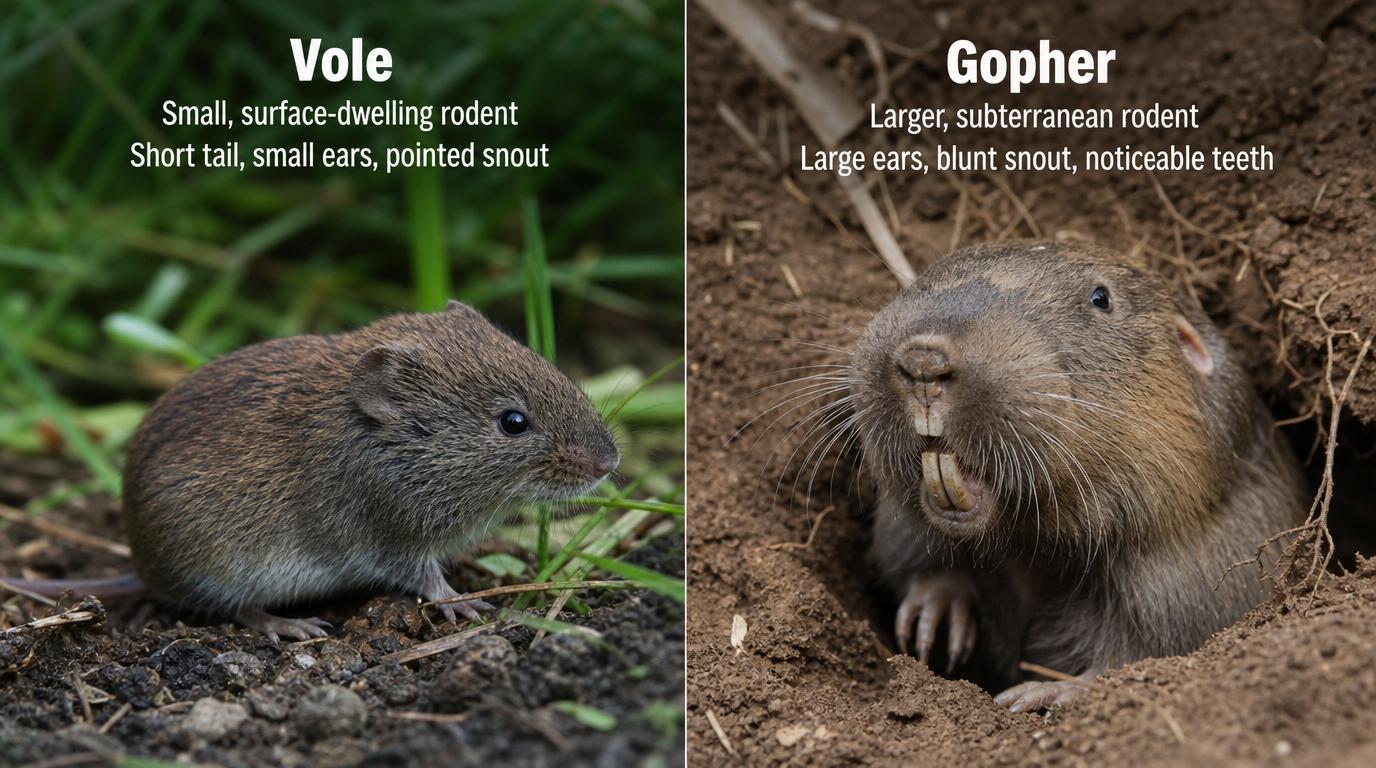
The core difference is depth. Voles — stocky, mouse-sized rodents sometimes called meadow mice — live and feed at the surface. They travel under grass cover and snow, clipping vegetation as they go, and their entire signature sits in the top two inches of your lawn. Pocket gophers live almost entirely underground, mining tunnel systems six to twelve inches down through Central Oregon's soft pumice soil and surfacing only to push out excavated dirt. A vole's damage is something carved into your lawn; a gopher's is something dumped onto it.
Bend's volcanic geology sharpens the contrast. Pumice and ash dig so easily that a single gopher here can throw up a dozen fresh mounds in a week — damage that looks like a whole colony. Meanwhile, our irrigated lawns sit as green islands in the high desert, concentrating vole populations that would be spread thin across a wetter landscape. Both pests hit harder here than the same animals do west of the Cascades.
The Side-by-Side Field Guide
Vole Signature
Surface worker · top 2 inchesClean, open burrow entrances about the size of a golf ball — and critically, no mound of soil beside them. They look like someone pressed a thumb into the lawn.
Winding 1–2" wide surface runways carved through the grass, connecting hole to hole like paths on a map — most dramatic at spring snowmelt.
Grass clipped to stubble along runways; bark gnawed in a ring at the base of shrubs and young trees; bulbs eaten from below.
Essentially none. Turf stays flat; damaged strips lift away like worn carpet.
Gopher Signature
Subsurface miner · 6–12 inches downCrescent or fan-shaped piles of fresh, finely sifted soil — with the exit hole plugged and offset to one side of the crescent. You will almost never see an open gopher hole.
New mounds appear in a rough line or arc across the yard over days — tracing the main tunnel being mined beneath.
Plants wilt suddenly or get pulled downward into the soil as roots are eaten from below; buried drip line gnawed through.
Constant. Mounds smother turf, seed weeds, and soft tunnel lines sink underfoot and scalp under the mower.
The 60-Second Backyard Test
1. Look for dirt. Piles of fresh soil on top of the grass? Gopher. Holes and trails with no soil piles at all? Vole. This single check resolves most yards.
2. Check the hole. An open entrance you can see down into is a vole (or, near rock and brush, possibly a chipmunk). Gophers plug their doors behind them — a gopher hole is a dimple of loose soil, not an opening.
3. Read the mound's shape. A gopher mound is a crescent with the plug at the notch. A perfectly round volcano-shaped mound with a center hole is neither animal — that's a mole, which is rare in Bend's dry soils.
4. Follow the damage downward. Chewed bark and clipped grass point to voles working the surface. Wilting plants, sunken strips, and irrigation pressure loss point to a gopher working the root zone.
Why the Distinction Changes Everything
The two animals demand opposite control strategies. Vole programs work the surface: low-profile trap systems set directly in active runways, timed around the snow season, paired with root guards on the trees and beds voles girdle under winter cover. The full program — including why fall trapping beats spring trapping — is laid out on our Vole Lawn & Yard Damage page.
Gopher control happens where the gopher lives: underground. Specialists probe from fresh mounds to find the main runway, open it surgically, and set paired traps facing both directions of travel — then maintain perimeter interception zones so the cleared ground stays cleared. The complete protocol is on our Pocket Gopher Control page.
Set vole traps for a gopher and they sit untouched on the surface while the tunnels grow. Probe for gopher runways in a vole yard and you'll find nothing six inches down while the turf disappears above. Identify first — sixty seconds with this guide, or a photo sent to the referral line — and the right program starts on day one.
Still Not Sure Which One You've Got?
Call the referral line and describe what you're seeing — or text a photo. A network yard specialist will confirm the pest and the program before anyone rolls.