
Every fall, Bend homeowners experience the same strange coincidence: the first truly cold night of October, and then — within a week or two — scratching in the walls, droppings in the garage, a flash of gray under the deck. It isn't a coincidence. It's one of the most predictable wildlife events in Central Oregon, and understanding its mechanics is the difference between getting ahead of it and paying for it all winter.
The Physics of the First Hard Freeze
Bend sits at roughly 3,600 feet on the dry side of the Cascades, and the high desert does temperature differently than the valley. Thin, dry air sheds heat the moment the sun drops, which is why a 72-degree October afternoon can hand off to a 20-degree night with nothing gradual in between. Climatologically, Bend's first hard freeze lands in early-to-mid October most years — and unlike the valley's slow autumn slide, it arrives like a switch being thrown.
For a deer mouse, that switch is a survival deadline. A mouse weighs around 20 grams — a body that small bleeds heat constantly and carries almost no fat reserve. Below freezing, a mouse in open sagebrush must eat nearly continuously just to maintain body temperature, at exactly the moment seed forage is disappearing and the cover that hides it from owls is thinning out. The energy math stops working. Biologists call what happens next thermal refuge seeking; exclusion specialists call it October.
And in a landscape of lava rock, juniper, and brush, the warmest, driest, most defensible refuge for miles is not a burrow or a rock pile. It's the heated structure you live in.
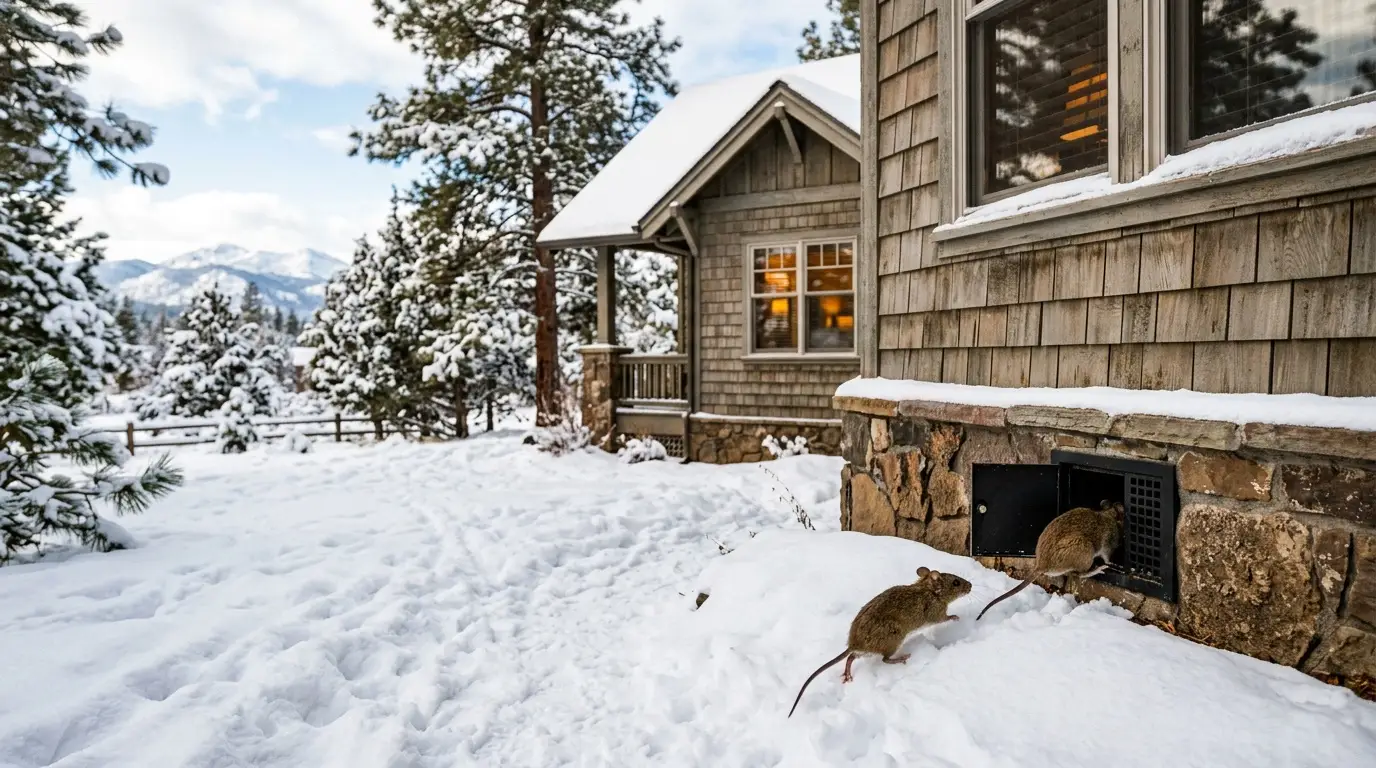
Who Moves, and From Where
Three species drive Bend's winter invasion, and they come from different directions. Deer mice are the volume players — native to the sagebrush steppe and ponderosa understory that borders nearly every neighborhood in town. A deer mouse's normal home range is small, often less than an acre, which means the mice that end up in your crawl space in November were living within a stone's throw of your fence line in September. When the freeze hits, they don't travel far; they simply trade the brush for the building.
House mice work the denser parts of town — established neighborhoods, commercial corridors, anywhere structures cluster. They overwinter indoors as a way of life and spread building-to-building along shared walls, fence tops, and utility lines. And bushy-tailed woodrats — pack rats — descend from the rimrock and rock outcroppings along the Deschutes canyon and Awbrey Butte, single territorial adults claiming garages, outbuildings, and engine bays as winter strongholds.
The movement itself follows infrastructure. Rodents avoid open ground where raptors hunt, so the migration flows along protected linear features: fence lines, landscape block walls, juniper hedges, woodpiles, canal banks, and the shadow line at the base of your foundation. A homeowner who walks that foundation line in late September — the way an inspector would — is looking at the exact route the invasion will take two weeks later.
Field note: network trapping data from Bend-area jobs shows call volume roughly tripling in the 14 days following the season's first sub-25°F night — and the entry points involved are overwhelmingly at or below grade. The crawl space, not the front door, is where winter begins.
Why the Crawl Space Wins Every Time
Most Bend homes stand on a vented crawl space — a dirt-floored cavity that holds a remarkably stable temperature all winter, warmed from above by your heated floors and sheltered from wind on every side. To a rodent fleeing a 15-degree night, it is purpose-built habitat: dark, dry, insulated with fiberglass nesting material, and connected to the kitchen above by plumbing chases that function like private stairwells.
Getting in is rarely a challenge. The average Bend foundation carries eight to sixteen vents, each screened with light builder mesh that has been through decades of freeze-thaw cycles, plus a perimeter of utility penetrations sealed with foam a mouse chews through in a night. A juvenile mouse passes through a gap of about six millimeters — the width of a pencil. This is why the permanent answer to the winter invasion is structural: closing every one of those openings with materials rodents can't defeat, the work covered in depth on our Crawl Space Exclusion page.
Once inside, the timeline accelerates. A female deer mouse that enters in October can produce a litter before Thanksgiving, and her offspring breed indoors through the winter — which is how "I heard something once in November" becomes a multi-generation colony by February. The biology, signs, and removal protocol for an established infestation are covered in our House Mice Elimination guide.
The Season, Month by Month
September — scouting. Populations are at their annual peak after a summer of breeding. Rodents are still living outside, but they're already running your foundation line at night, learning where the warm air leaks out. Gnaw marks appear at vent corners and door sweeps before anything moves in.
October — the surge. The first hard freeze triggers mass movement, usually compressed into ten to twenty days. Every gap found during September scouting gets used. This is the month exclusion work pays for itself fastest — and the month it gets hardest to schedule.
November through February — settlement. Movement outside drops with the snow; activity inside climbs. Scratching becomes regular, food caches grow, and indoor breeding begins. Infestations discovered now are established, not arriving — they call for trapping and cleanup, not just sealing.
March through May — the false ending. As nights warm, some rodents drift back to the landscape and homeowners assume the problem "went away." The scent trails, entry points, and nest sites all remain — pre-mapped for next October. This is why untreated homes get hit in consecutive winters, almost without exception.
Getting Ahead of October
The encouraging part of all this predictability: a defense mounted in late summer works. Walk your foundation and note every vent, gap, and penetration. Pull woodpiles and stored materials away from the wall. Trim juniper and limbs back from the roofline. Watch the garage door corner seals — the most-used entry in newer neighborhoods. And if your home has ever had winter rodents, treat that as a guarantee of a return visit and get the envelope professionally sealed before the freeze, not after the scratching starts.
The winter invasion is not bad luck, and it isn't a cleanliness problem. It's geography, physics, and biology running on schedule — and a sealed structure is the one variable in that equation a homeowner fully controls.
Beat the Freeze to Your Foundation
A network specialist can inspect and seal your home's envelope before the October surge. Referrals answered 24/7 by a human in Bend.