
House Mice Elimination
For Bend's First-Freeze Invasion Season
When the high desert drops below freezing — often overnight, sometimes by mid-October — every field mouse within scent range of your foundation makes the same decision: move indoors or die. The vetted specialists in our network don't manage that invasion with bait stations. They end it: complete trapping of the mice already inside, then permanent sealing of every gap they used to get in.
- ✓ Full structural inspection first — every entry point mapped and photographed before a single trap is set
- ✓ No rodenticides inside your home — no carcasses decomposing in wall cavities, no risk to pets or raptors
- ✓ Trapping ends with exclusion — the job isn't done until the envelope is sealed and verified mouse-free
Request Local Inspection
We match you with a rodent specialist in Bend. Pronto! 🐭
Answered by a real person. Describe the rodent activity you're seeing or hearing and we'll match you with the right specialist!
The First Hard Frost Empties the Sagebrush — Into Your Crawl Space
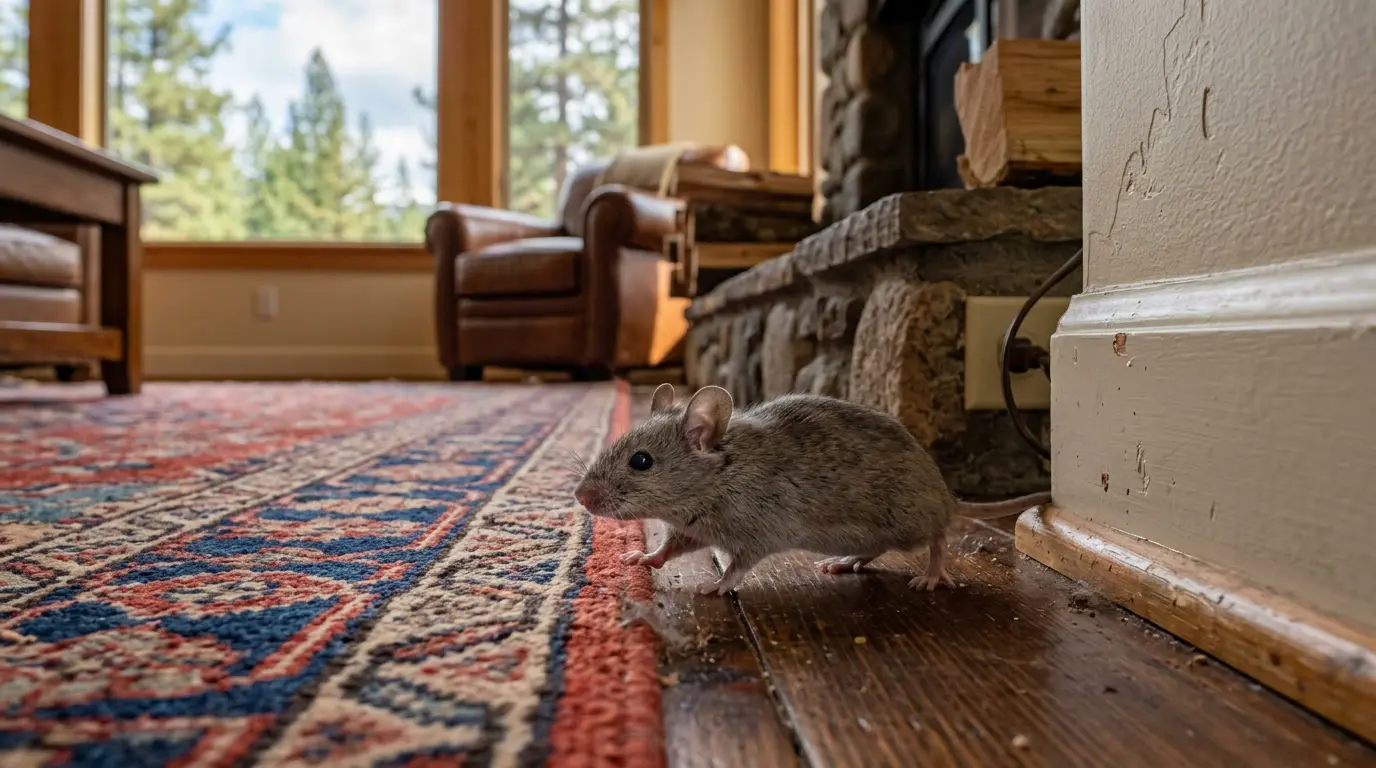
Bend's autumn doesn't taper — it snaps. A 75-degree afternoon in early October can hand off to a 22-degree night, and that single freeze is the starting gun for the year's largest rodent migration. Deer mice and house mice that spent the summer thriving in the sagebrush flats and ponderosa duff suddenly need a heated structure, and the average Bend home offers them dozens of ways in.
The pattern is hyper-local. In NW Crossing, newer construction backs directly onto Discovery Park and the Tree Farm's open forest — mice follow landscape walls and paver edges straight to garage door corners. In Larkspur and the neighborhoods around Pilot Butte, mature junipers and 1970s–90s foundations mean weathered vent screens and settled sill gaps that a juvenile mouse passes through without slowing down. Along Awbrey Butte, rock outcroppings hold resident deer mouse colonies year-round, just feet from daylight basements.
By the time you hear scratching above the ceiling or find droppings under the kitchen sink, the colony has usually been established for weeks — and it is marking scent trails that will guide next season's mice to the same gaps. That's why trapping alone never ends the problem, and why every network specialist pairs it with structural exclusion.
Signs Mice Beat the Frost Inside
- Scratching or skittering in walls and ceilings after dusk
- Droppings along baseboards, under sinks, in garage corners
- Shredded insulation or nesting material in stored boxes
- Pet food disappearing or gnawed packaging in the pantry
- A musky ammonia odor in the crawl space or utility room
The Structural Inspection: Mapping Every Way In
A trap catches a mouse. An inspection catches the problem. Before any trapping begins, your network specialist walks the entire structure — exterior and interior — and documents every penetration a mouse can use, photographed and marked on a diagram you keep.
Foundation Perimeter & Vents
Every foundation vent, sill-plate gap, and utility penetration at ground level — the freeze-thaw cycles at Bend's elevation split vent screens that look intact from five feet away.
Garage Doors & Slab Junctions
Garage door corner seals are the single most common entry point in newer Bend neighborhoods like NW Crossing — a hardened, gapped corner gasket is an open door all winter.
Crawl Space Interior
Rub marks, droppings, and tunneling in the vapor barrier reveal active runways — and show exactly where mice are passing between the crawl space and the living space above.
Attic, Roofline & Utility Chases
Mice climb. Gable vents, roof returns, and the plumbing and wiring chases that run floor-to-attic get the same scrutiny as the foundation — especially on Awbrey Butte homes built into slope.
The Trapping Protocol: Fast, Verified, Poison-Free
Network specialists run trapping the way a contractor runs a punch list — methodically, on the evidence, with documentation. No bait stations bleeding poison into the food chain; no mice dying out of reach behind your drywall in week three of an "ongoing service plan."
Traps on Runways, Not Guesses
Mice travel walls, not open floors. Trap lines go exactly where the inspection found rub marks and droppings — garage walls, crawl space sills, attic joist bays — at protocol density for the activity level.
48-Hour Check Cycles
Your specialist returns on a fixed schedule to clear, reset, and reposition — and tracks the catch curve. When captures fall to zero across two consecutive cycles, the interior population is confirmed cleared.
Sealed the Same Visit Activity Ends
As the catch curve drops, mapped entry points get permanently closed — copper mesh, hardware cloth, rodent-rated sealant — so the cleared house stays cleared through the next freeze, and the one after that.
Deer Mouse Safety Protocol
Central Oregon deer mice can carry hantavirus. Droppings and nest sites are never swept or vacuumed dry — specialists follow wet-method decontamination, and heavy contamination is referred to network sanitization techs.
Often Paired With House Mice Work
Crawl Space Exclusion
Permanent vent armor and sill sealing for the most common mouse highway in Bend homes.
Learn More →Sanitization
Hantavirus-protocol decontamination of droppings, nests, and scent trails that attract the next colony.
Learn More →Insulation Removal
Soiled attic and crawl space insulation replaced after heavy or long-running infestations.
Learn More →The First Freeze Won't Wait. Neither Should You.
Our referral line is answered by a human in Bend — 24/7. We'll connect you with the right local expert for your situation.