
Drive any Bend neighborhood and you'll see them tucked against foundations: little black boxes, refilled four times a year by a route technician, billed monthly forever. The bait station is the most common rodent "solution" in Central Oregon — and it is also the reason so many homes here have a rodent problem every single winter. This article makes the case our network is built on: poison manages a symptom on a subscription; sealing the structure fixes the cause, once.
What a Bait Station Actually Does
Modern rodenticides are mostly anticoagulants. A rodent feeds at the station, then dies of internal bleeding — not instantly, but three to seven days later, somewhere else. Read that timeline against your home's layout and the central problem comes into focus: the mouse eats at the box by your foundation on Monday and dies inside your wall cavity on Friday. The bait box doesn't keep rodents out of your house. It guarantees that some of the rodents in your house die where you can't reach them.
Meanwhile, the station itself is a feeding site — a reliable calorie source that rodents incorporate into their foraging routes. Kill six mice in October and the scent-marked territory, the open entry points, and now a dependable food box are all still there for the next wave coming out of the sagebrush. Nothing about the situation that attracted rodents has changed; one variable — a food source — has actually improved.
The Dead-in-the-Wall Loop
Every exclusion contractor in our network has the same story on repeat: a homeowner calls about a smell, not a sighting. A poisoned rodent that dies in a wall void, a ceiling cavity, or under the insulation announces itself over the following two weeks — an odor that arrives through the registers, flies at the windows, and a carcass that frequently requires cutting drywall to remove. Then the cavity needs decontamination, because the decomposition site is now a scent beacon of its own.
And here is the loop in full: poison kills a portion of the population → carcasses accumulate in voids → entry points stay open → new rodents arrive each fall → the route technician refills the boxes → the invoice arrives monthly. Notice whose problem is solved by that cycle. Recurring baiting isn't a failed version of pest control; it's a successful business model. The contract renews precisely because the problem never ends — and it never ends because the structure was never fixed.
The question that reframes everything: if quarterly baiting worked, why would it need to be quarterly — forever? No other home repair is sold this way. You don't subscribe to a roof patch. You fix the roof.
Secondary Poisoning: The High Desert Pays the Bill
A poisoned rodent doesn't just die in your wall. In its final days it gets slow, disoriented, and active in daylight — which makes it exactly the animal a predator catches first. Central Oregon's skies are full of those predators: great horned owls hunting Bend's neighborhoods every night, red-tailed hawks working the canal lines, kestrels, golden eagles over the open country east of town. When they eat anticoagulant-loaded prey, the poison passes up the chain. Wildlife rehabilitation centers across Oregon consistently find rodenticide residues in the majority of dead raptors they test — birds that were, ironically, the high desert's free, full-time rodent control. A single great horned owl family consumes well over a thousand rodents a year. Every poisoned owl is a contract Bend's ecosystem loses.
The risk doesn't stop at wildlife. Anticoagulant baits are palatable by design — and rodenticide ingestion remains one of the most common toxin calls to veterinary poison control nationwide, whether from a dog raiding a station knocked loose in a crawl space or from scavenging a poisoned carcass in the yard. In a town where nearly every household has a dog and the deer mice may carry the bait two hundred feet before dying, "tamper-resistant" describes the box, not the outcome.
Exclusion: Fixing the Building Instead of Billing the Symptom
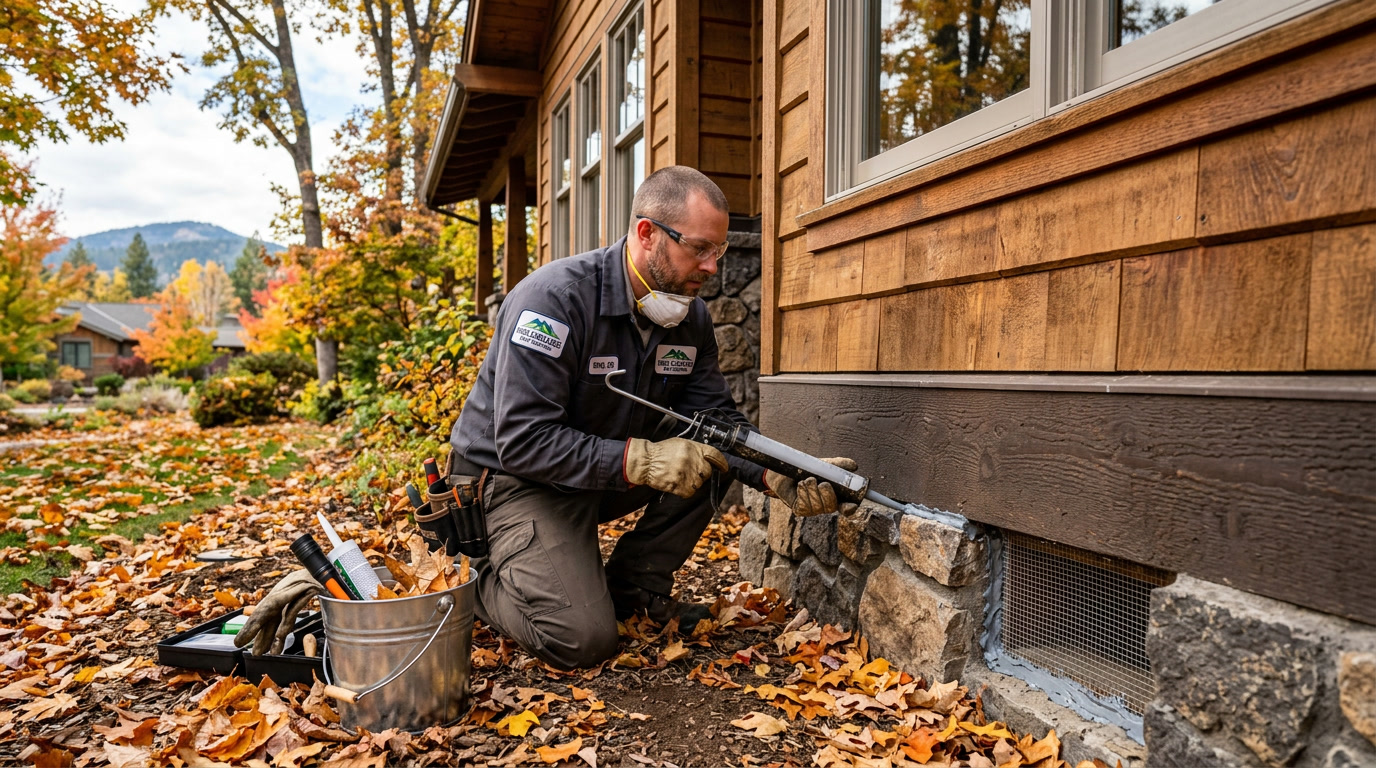
Structural exclusion starts from a different premise: rodents are in your home because your home has openings, and a building's openings can be counted, photographed, and closed. The average Bend inspection finds forty-plus entry points, and they cluster in two zones. Below, the foundation line — aging vents, sill gaps, and pipe penetrations — sealed with welded steel and mortar as detailed on our Crawl Space Exclusion page. Above, the roofline — eave returns, fascia gaps, soffit and gable vents that climbing rodents reach from trees and fences — closed with custom-bent steel flashing and exclusion carpentry, covered on our Attic & Roofline Sealing page.
The materials are the argument. A rodent's teeth defeat foam, plastic, rubber, and wood — given a winter, all of them. They do not defeat 16-gauge welded steel mesh, galvanized vent guards bedded in mortar, or stainless wool packed into a pipe gap and faced with elastomeric sealant. These are construction-grade components rated for decades of Bend's freeze-thaw cycles. Done once, to standard, with the animals trapped out first — never sealed in — the work doesn't have a renewal date.
The Financial Math: Subscription vs. Investment
Run the numbers the way you would for any other home decision. A typical Bend bait contract bills $45 to $75 a month. Over five years that's $2,700 to $4,500 — over ten, up to $9,000 — with the entry points open the entire time, the wildlife cost accruing silently, and nothing to show a buyer at sale except an active pest contract on the disclosure form. A complete structural exclusion — foundation and roofline together — is a one-time project in the same range as just a few years of baiting, and it appreciates rather than expires: a documented, transferable-warranty exclusion package turns the most commonly flagged item on a Bend pre-sale inspection into a closing-table asset.
One approach is a permanent line item in your budget that poisons the owls keeping the rest of the rodent population down. The other is a single dated invoice, a binder of before-and-after photos, and a house that simply doesn't have a way in anymore. That's the entire case — and it's why every specialist in this network leads with steel, not bait.
Ready to Cancel the Subscription for Good?
A network specialist can audit your home's full envelope — foundation to roofline — and quote the one-time fix. Referrals answered 24/7 by a human in Bend.