
Crawl Space Crawl-In Exclusion
Seal the Front Door Rodents Use Most
Most Bend homes stand on a vented crawl space — and on most of them, that crawl space is the single largest rodent entry system on the property: a perimeter of aging foundation vents, settled sill gaps, and unsealed pipe penetrations, all leading to a warm, dark, insulated cavity under your floors. Crawl-in exclusion closes that entire envelope with steel — once — and it stays closed.
- ✓ Welded steel mesh and metal vent armor — materials rodents physically cannot chew through
- ✓ Every vent, joist gap & penetration documented — photographed before and after, mapped on a diagram you keep
- ✓ Warranty-backed, transferable workmanship — exclusion that adds documented value at resale
Request Local Inspection
We match you with a rodent specialist in Bend. Pronto! 🐭
Answered by a real person. Describe the rodent activity you're seeing or hearing and we'll match you with the right specialist!
Your Crawl Space Has More Openings Than Every Door and Window Combined
Walk the foundation of a typical Bend home and count: eight to sixteen foundation vents, a gas line, an AC line set, irrigation supply, hose bibs, the main electrical service, sewer and water penetrations, and a crawl space access door — every one of them a designed hole in your home's perimeter. The builder screened and sealed them to the standard of the year the house was built. Bend's climate has been working on them ever since.
At 3,600 feet, foundation vents live through 80 to 100 freeze-thaw cycles a winter. Light-gauge builder screens rust, embrittle, and split — often invisibly, behind the louvers. Sill plates shrink away from concrete as framing dries in high-desert air, opening gaps along the rim. The original spray foam around pipe penetrations is the softest material on the wall, and a mouse chews through it in one night.
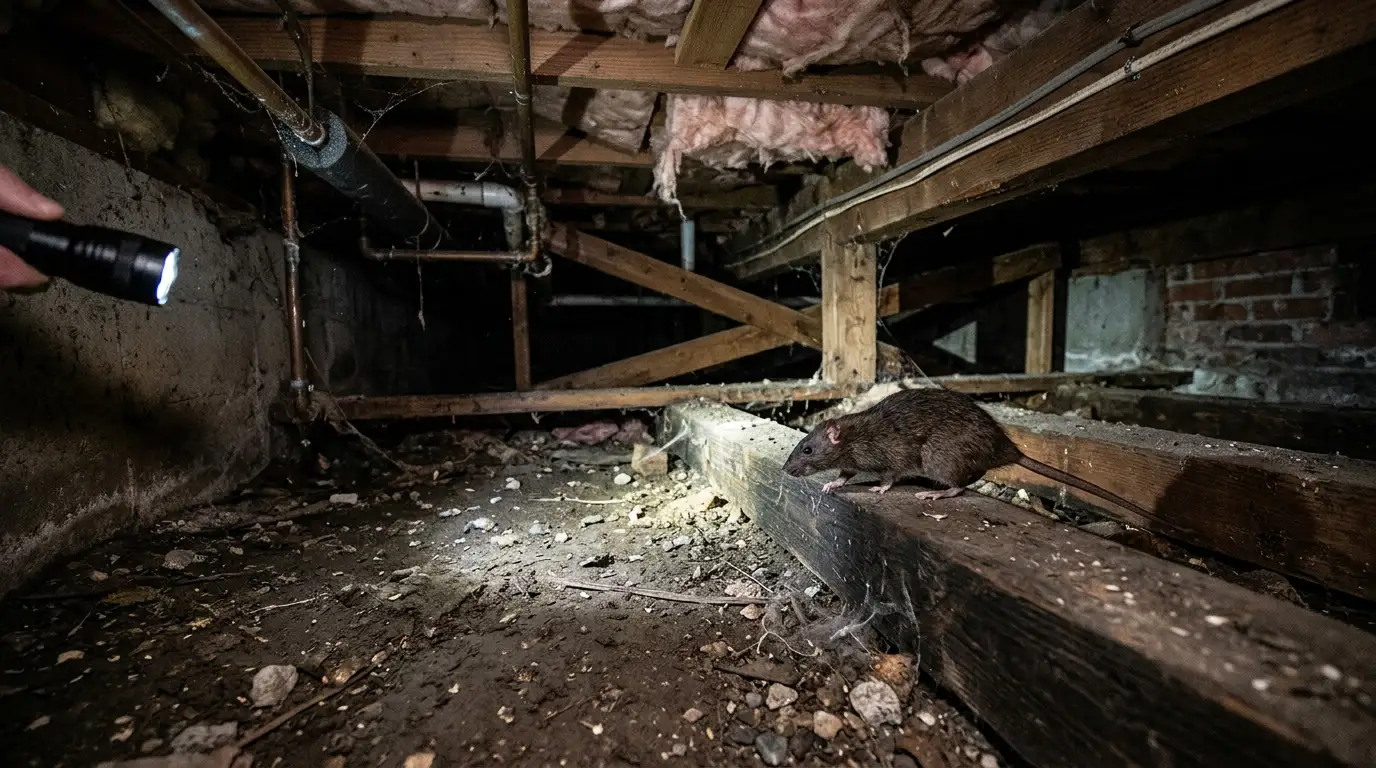
Behind those failures sits the best winter habitat on your property: a dirt-floored, wind-sheltered cavity holding steady above freezing, lined with insulation for nesting, with your subfloor plumbing chases offering a private staircase to the kitchen. This is why crawl spaces are where nearly every Bend rodent problem starts — and why sealing one properly ends problems that bait stations have managed for years.
Signs Your Crawl Space Is Open
- Vent screens that flex, flake rust, or show daylight at corners
- Scratching or movement sounds under the floor at night
- Cold floors and winter drafts at baseboards
- Musky odor rising from floor registers
- Tunneled or fallen insulation visible from the access door
- Droppings on the vapor barrier or atop the sill plate
A Full-Perimeter Seal, Executed Like a Trade
Crawl-in exclusion is contractor work performed inside and outside the foundation line. A typical Bend home takes one to two days. Nothing is "treated" — everything is built.
Full-Envelope Assessment
Every vent, penetration, sill gap, and the access door is inspected, measured, photographed, and plotted on a foundation diagram — the scope of work you approve before anything is sealed.
Steel Vent Armor
Failed builder screens are replaced with welded galvanized steel guards, anchored into concrete and bedded in mortar — preserving the code-required airflow your crawl space needs in our dry climate.
Rim Joist & Sill Sealing
Shrinkage gaps along the sill plate and every rim joist opening are packed with stainless steel mesh and faced with rodent-rated elastomeric sealant — flexible through seasonal movement, unchewable for the life of the house.
Pipe Penetration Rebuilds
Gas, water, AC, electrical, and irrigation penetrations get the annular gap rebuilt: steel mesh packing, sealant facing, and steel escutcheon collars where lines pass through at grade.
Access Door Rebuild
The most-abused opening on the foundation gets a gasketed, flush-fitting door or hatch with steel-lined edges — easy for you and your inspector to open, closed to everything else.
Verification & Warranty
A follow-up visit confirms zero new activity, you receive the full before/after photo set and foundation diagram, and the workmanship warranty — transferable at sale — goes on file.
Steel Outlasts Every Bait Contract Ever Written
A quarterly bait service treats the rodents. Crawl-in exclusion fixes the building. Only one of those addresses why mice are in your crawl space — and only one of them is still working in ten years without another invoice.
The arithmetic is blunt. A typical Bend bait subscription runs $45–$75 a month, every month, indefinitely — $2,700 to $4,500 over five years — while the entry points stay open and the crawl space stays contaminated. A full crawl-in exclusion is a one-time project at comparable or lower total cost that removes the vulnerability itself, in materials rated for decades of freeze-thaw, with workmanship warrantied in writing.
It also pays at the closing table. Bend home inspectors flag open vents and rodent sign on nearly every pre-sale crawl space report — a documented exclusion package with photos, diagram, and transferable warranty turns your home's most commonly flagged defect into a selling point.
What's in Your Completion Package
- Foundation diagram with every sealed point numbered
- Full before/after photo documentation set
- Materials specification sheet for your records
- Transferable workmanship warranty certificate
- Follow-up verification visit report
Often Paired With Crawl Space Exclusion
Insulation Removal
Soiled subfloor insulation comes out before the seal goes on — no point locking contamination inside.
Learn More →Sanitization
Hantavirus-protocol decontamination of the crawl space, sealed in clean condition.
Learn More →Attic & Roofline Sealing
The other half of the envelope — most full-home exclusions seal the roofline in the same project.
Learn More →Seal It Once. Stop Paying Monthly for an Open Foundation.
Our referral line is answered by a human in Bend — 24/7. We'll connect you with the right local expert for your situation.