
Attic & Roofline Sealing
Because Rodents Don't Need the Ground Floor
On a wooded Central Oregon lot, the roof is not out of reach — it's the preferred route. Pack rats and deer mice run ponderosa limbs and fence lines straight onto the eaves, then work the construction gaps every roofline has: roof returns, fascia joints, soffit vents, gable louvers. Network specialists close the upper envelope with exclusion carpentry and heavy-gauge steel flashing, finished to match the house and rated for Cascade snow loads.
- ✓ Heavy-gauge steel flashing — color-matched, snow-load-safe metal work at every junction rodents exploit
- ✓ Exclusion carpentry, not caulk — chewed fascia and soffit sections rebuilt, not patched over
- ✓ Attic verified clear before closing — sealing never traps an animal inside your insulation
Request Local Inspection
We match you with a rodent specialist in Bend. Pronto! 🐭
Answered by a real person. Describe the rodent activity you're seeing or hearing and we'll match you with the right specialist!
On a Ponderosa Lot, Every Limb Is a Ramp to Your Attic
Homeowners armor the foundation and forget the roof — and on Central Oregon's wooded lots, the roof is where the traffic is. A pack rat climbs vertical bark effortlessly; a deer mouse runs a fence top, a trellis, or a juniper limb and steps onto your shingles without breaking stride. In Sunriver, where homes sit under continuous lodgepole and ponderosa canopy, roofline entries outnumber ground-level entries on most inspection reports. The same is true on Bend's tree-heavy west side — River West, Summit West, the Tree Farm — and on the big pine lots of Deschutes River Woods.
Once on the roof, a rodent doesn't need a hole — the roofline already has openings built into it. Snow-country framing leaves a gap where the fascia meets the roof deck at every eave return. Soffit vents are screened with the same light mesh as 1990s foundation vents. Gable louvers stand behind window screen at best. The drip edge lifts where ice dams have worked it for twenty winters. None of it was designed with a climbing rodent in mind.
And the attic behind those gaps is the best real estate in the house: undisturbed, insulated to R-49, warmed by everything below it. By the time you hear scratching above a bedroom ceiling in January, the nest has usually been active since the first October frost.
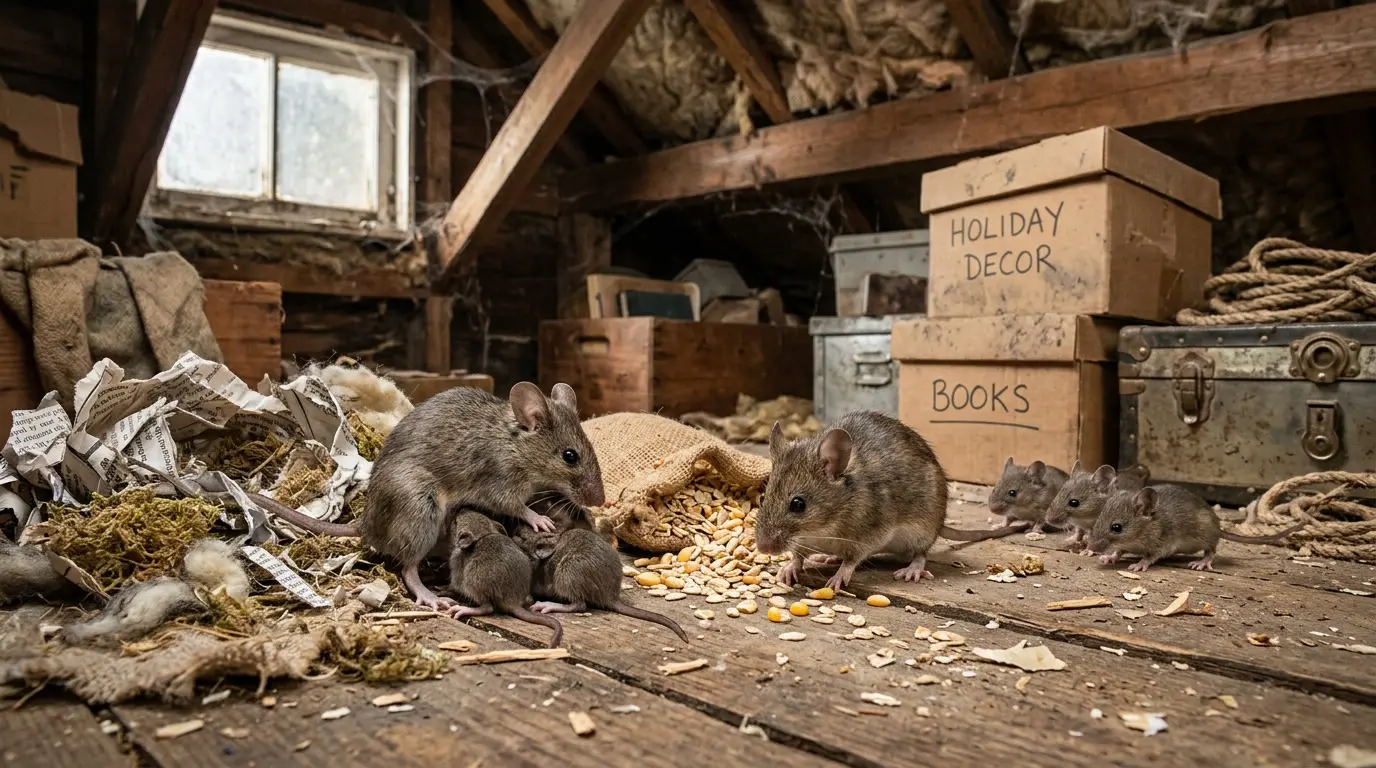
Signs of Roofline Entry
- Scratching or rolling sounds above ceilings, especially at dusk
- Gnaw marks or staining on fascia boards and eave corners
- Tunnels and trails visible in attic insulation
- Droppings along the attic's perimeter top plates
- Tree limbs within six feet of the roof edge
- Chewed or pushed-out soffit and gable vent screens
Four Junctions, One Standard of Closure
Every roofline inspection works the same four zones — the junctions where framing, trim, and ventilation meet, and where every builder leaves gaps.
Roof Returns & Junctions
Where a lower roof dies into a wall, where dormers meet the main deck, where additions joined the original structure — every transition hides a framing gap behind the trim. These are the #1 pack rat entry on two-story Bend homes.
Fascia Boards & Drip Edge
High-desert UV and ice dams split fascia and lift drip edge, opening a slot along the entire eave. Rodents gnaw soft, weathered fascia wider in a night — chew damage here almost always means an active route.
Soffits & Eave Vents
Continuous soffit vents and button vents are screened for insects, not rodents. A mouse pushes through aged mesh with its nose. Sagging soffit panels also open corner gaps wide enough for squirrels and pack rats.
Gable, Ridge & Utility Openings
Gable louvers, ridge vent ends, bath fan terminations, and the chase where the chimney or plumbing stack exits the roof — high, hidden, and rarely checked since the house was built.
Exclusion Carpentry + Heavy-Gauge Steel Flashing
Foam and caulk have no business on a roofline — rodents chew both, and Cascade snow tears them out anyway. The network standard is metal and lumber, installed by specialists who work rooflines the way roofers do: harnessed, staged, and to a finish standard you'd accept on the front of the house.
Full Roofline & Attic Survey
Every eave, return, vent, and penetration inspected from ladder and roof; the attic walked and mapped for nests, trails, and daylight. Overhanging limbs within jumping range are flagged for trimming.
Clear-Out Before Closure
Active attics are trapped clear — or fitted with one-way exit doors at the main entry — before anything is sealed. Closing a roofline on a live animal means a carcass in your insulation; the protocol makes that impossible.
Exclusion Carpentry
Chewed and weather-split fascia is cut out and replaced, sagging soffit panels are re-hung and backed, and rotted eave returns are rebuilt — primed and painted to match. The structure is restored first, then armored.
Heavy-Gauge Steel Closures
Roof returns, deck-to-fascia gaps, and drip-edge lifts are closed with custom-bent heavy-gauge steel flashing; soffit, gable, and ridge openings get stainless rodent mesh behind their original grilles. All of it color-matched and rated for snow load and ice.
Documentation & Warranty
Before/after photos of every closure, a roofline diagram for your records, and a written workmanship warranty — the same documentation package as the network's crawl space standard.
Often Paired With Roofline Work
Pack Rats
The roofline's most capable climber — nest removal and deterrence for the animal using the route.
Learn More →Insulation Removal
Tunneled, soiled attic insulation replaced once the roofline is verified sealed.
Learn More →Crawl Space Exclusion
The lower half of the envelope — most full-home exclusions seal both in one project.
Learn More →Scratching Overhead? The Route Is Already Open.
Our referral line is answered by a human in Bend — 24/7. We'll connect you with the right local expert for your situation.