Fair warning, given honestly: this guide will teach you to do a real rodent inspection of your own crawl space — the same zones a professional checks, in the same order. It will also be honest about what that involves: eighteen to thirty inches of clearance, a dirt floor in the dark, January air at ground temperature, and a slow crawl on your back under your own plumbing. Most homeowners do this exactly once. But once is genuinely worth doing — because knowing what's under your house is the difference between guessing and acting.
Before You Go Under: The Safety Rules Are Not Optional
Central Oregon's deer mice can carry hantavirus, which spreads through dried droppings and urine dust that goes airborne when disturbed. A crawl space is an enclosed, unventilated box of exactly that dust. This is why the single most important rule of DIY inspection is: you are going under to look, never to clean. No sweeping, no shop-vac, no pulling out droppings or old insulation bare-handed — disturbance is the exposure mechanism, and heavy cleanup belongs to hantavirus-protocol sanitization techs with containment and the right respirators.
Minimum Gear Before the Hatch Opens
- Respirator: N95 at absolute minimum; a P100 half-face respirator is the real standard
- Headlamp plus a backup flashlight — never your phone light alone
- Disposable coveralls or clothes that go straight into the wash, gloves, and eye protection
- Knee pads and a beanie — pumice soil and joist nails are unkind
- A spotter: someone in the house who knows you're under it and checks in
- Your phone in a zip bag — for photos, and because you brought a spotter, not a substitute for one
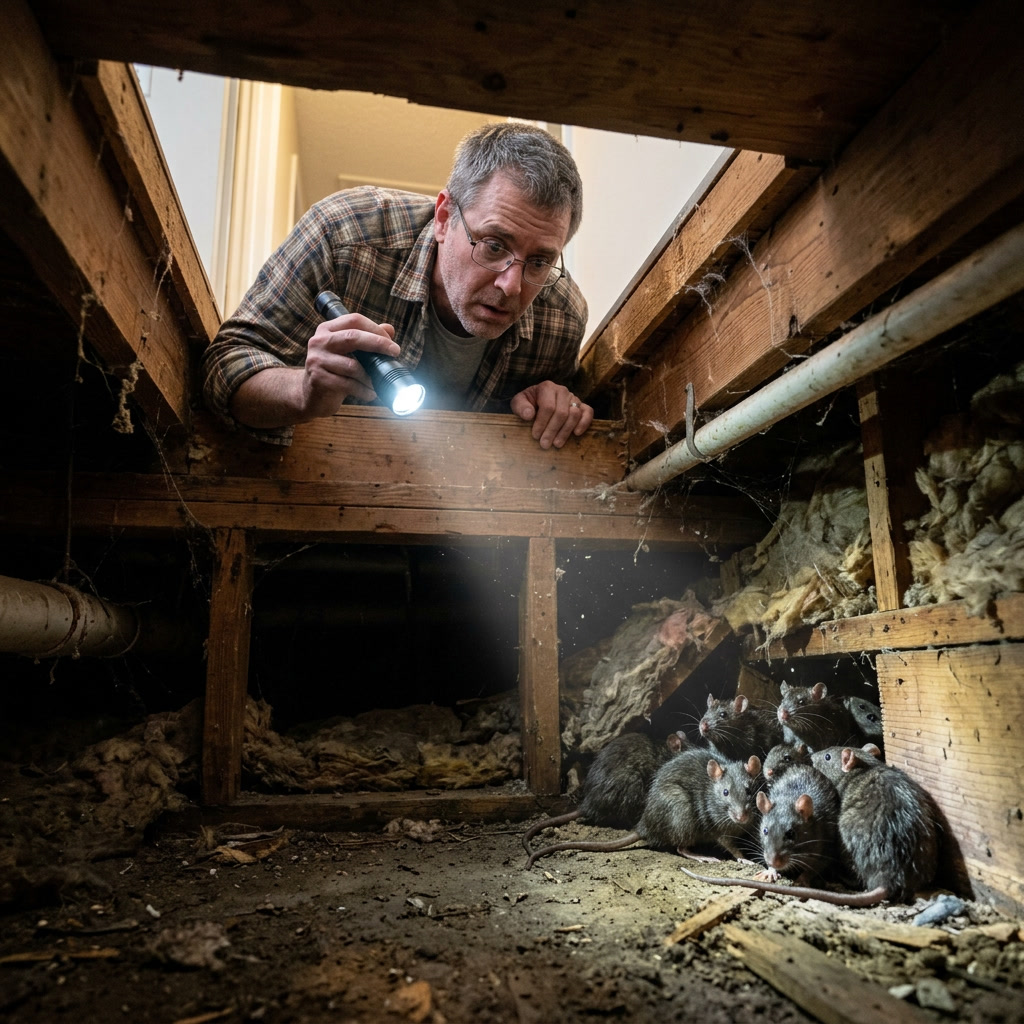
And know the situations where the DIY inspection ends at the hatch. If you open the access door and are hit with a strong ammonia or musk odor, see widespread droppings within arm's reach, find standing water, see damaged wiring, or hear active movement — close the door. Those findings have already answered the question the inspection was asking. Call the line and let a professional in full PPE take it from there.
The Inspection, Step by Step
Step 1 — Walk the exterior first. Before going under, circle the foundation in daylight. Note every vent (flex the screens gently — rusted mesh crumbles), every pipe and wire penetration, and the condition of the access door itself. Photograph anything gapped, chewed, or rusted. This ten-minute walk builds the map of where evidence should appear inside — a gnawed vent on the north wall predicts a trail on the north sill.
Step 2 — Open the hatch and stop. Don't enter yet. Let it air for a few minutes, then use your nose and ears at the threshold. Sharp ammonia means an active or recent population. Sweet decay means a carcass. Movement means today is not a DIY day. A neutral, earthy smell is your green light.
Step 3 — Read the vapor barrier. The plastic sheeting on the dirt is your evidence log. You're looking for three things: tears and ripples where rodents have tunneled beneath it (a mouse highway looks like a raised vein under the plastic), droppings on top of it — concentrated piles mark nest zones, scattered lines mark travel routes — and tracks and tail drags in any dust film. A torn, lifted barrier against the foundation wall almost always marks an entry point directly above.
Step 4 — Look up into the insulation. Roll onto your back and run the headlamp across the subfloor insulation between the joists. Healthy fiberglass is flat, full, and uniform. Rodent-worked insulation sags, shows round tunnel openings, sheds chewed tufts onto the barrier below, and carries yellow-brown urine staining at the nest pockets. Note every bay that's tunneled, fallen, or stained — if that's more than a bay or two, the material is past saving, and the HEPA removal process explains what happens to it. Do not pull at it to check; photograph it.
Step 5 — Follow the sill line. The top of the foundation wall — where the wooden sill plate meets concrete — is the rodent interstate. Work the perimeter with your light held at a low angle and look for rub marks (greasy, dark smudges where fur drags the same route nightly), droppings strung along the plate, gnaw marks at corners and penetrations, and — the giveaway — daylight. Kill your headlamp for ten seconds in each quadrant; any pinprick of light through the foundation line is a confirmed opening.
Step 6 — Document and exit clean. Photograph everything with something for scale, note locations against your exterior map, then back out the way you came. Coveralls and gloves go straight into a trash bag at the hatch; clothes go to the wash; you go to the shower. The photo set you just made is exactly what a specialist needs to quote the fix accurately — often without a second crawl.
Reading Your Findings
Clean: intact barrier, full insulation, no droppings, no daylight. Congratulations — and put a reminder in your calendar for next September, because that's when the pressure arrives.
Light evidence: scattered old droppings, one questionable vent, insulation intact. You're early — which is the cheapest possible time to seal the envelope. This is the textbook setup for exclusion before the first freeze.
Established activity: tunneled barrier, worked insulation, rub-marked sills, odor. This is no longer an inspection problem — it's a trapping, removal, decontamination, and sealing project, in that order, and every week it runs adds contamination the cleanup has to address.
The Honest Part
You now know how to do this properly. You also now know what "properly" costs: a respirator and coveralls, an hour of crawling through forty-degree darkness with your nose eight inches under the plumbing, and the discipline to look at a pile of droppings and not clean it up. Some homeowners genuinely don't mind, and this guide is for them. For everyone else, there's an easier sentence to type than "where did I put my knee pads": a network specialist will do all of the above — plus the parts that need a borescope, a moisture meter, and twelve years of knowing what Bend sill plates look like — and hand you the photo-documented findings and a written scope. You stay upstairs with the coffee.
Either path ends the same way: with you knowing exactly what's under your house before October decides for you. Pick the one you'll actually do this month.